
A kiss in Mecca, a red carpet in Washington
A few days ago, in Makkah, two nationals of Bangladesh were executed by Saudi Arabia. One of them, a young man from Brahmanbaria named Nazrul Islam, son of Abdul Basir, had gone to Saudi Arabia on 10 November 2022 to work as a cleaner, by his family's account at the Grand Mosque itself, on money his father had borrowed from relatives to send him abroad. Eight months later he was in a cell. Three years after that he was dead.
Early in the evening of 14 October, Bangladesh time, someone in Saudi Arabia rang the family's home in Brahmanbaria to say that Nazrul had been executed. Until that call, he had been ringing home every Sunday from the prison where he was held over an alleged "immoral act" in a Makkah mosque.
His last conversation with his parents, on 11 October, lasted about two and a half minutes. Nobody warned them. His mother, Rahima Begum, has barely stopped crying since; she says the allegations against her son are false. His aunt, Abeda Begum, collapsed on hearing the news and died in the early hours of the following morning.
His father, who himself spent twenty-four years as a migrant worker in the kingdom before returning home in 2020, borrowed six lakh taka to send his son there and still owes most of it. He wants one thing: to see the body once. It has not come home.
The people who were supposed to protect them learned of the executions from the news. A confidential memo from the Bangladesh Consulate General in Jeddah to the expatriates' welfare ministry, dated 18 October, lays out what the mission knew and when. Nazrul Islam and Sweety Akhtar both worked as cleaners for the same contractor. He was detained on 1 August 2023 under the kingdom's cybercrime law; she was picked up the following day on an allegation of adultery.
They sent him to Jeddah Correctional Facility and her to the women's prison. On 30 September this year, the Saudis handed the consulate a list of roughly 2,500 Bangladeshi prisoners. Both names were on it, tagged "ICT" and "adultery". Not a word about a death sentence. Two weeks later they were beheaded.
The consulate's memo says that neither the embassy nor the consulate was told, officially or unofficially, of the sentences or the executions. It says the mission knows of no previous case of a Bangladeshi being put to death in the kingdom for either offence. It says it cannot tell whether the two had lawyers, or interpreters of their own choosing, when the charges were put to them. And it records that no family member of either had ever applied to the mission for help.
Why would they? For three years, nobody told them there was a capital case to fight. The Saudi interior ministry's own statement, which spelt the woman's name "Siti" instead of "Sweety", said only that a competent court had sentenced the pair to death under ta'zir, that the verdict had been upheld, and that a Royal Order had been issued to carry it out.
It did not say what the act was. It did not name the mosque. It did not say when they were arrested.
Dhaka's response has been a study in deference. On Sunday, Foreign Secretary (East and West) Md Nazrul Islam met the Saudi ambassador, Abdullah Zafer bin Abiyah, to seek details; officials quickly told reporters it was not a summons. State Minister for Foreign Affairs Humaiun Kobir called the executions "very disappointing", praised Saudi Arabia as a friendly partner, and said Prime Minister Tarique Rahman's government hoped relations would grow stronger still.
His colleague Shama Obaed Islam said Bangladesh was still waiting for a copy of the verdict. Both sides agreed that Bangladeshis must remain mindful of the host country's laws. A ministry official explained that it is humanly impossible for a mission to follow up on every case.
Two citizens were tried in secret, condemned in secret, and killed without a telephone call to their embassy, and the loudest thing their government could say was that bilateral ties would not be affected.
Nazrul and Sweety are not exceptions to the rule. Saudi authorities executed 356 people in 2025, a record for the kingdom, and official data show 243 of them were put to death in drug-related cases. Foreign nationals convicted of non-lethal drug offences made up the majority, according to data compiled by Reprieve and the European Saudi Organisation for Human Rights, and for the first time in a calendar year more foreigners were executed than Saudis.
The kingdom is also a party to the Convention on the Rights of the Child, which forbids the execution of anyone for a crime committed before the age of eighteen. That did not stop it: 2025 brought repeated calls to halt the execution of those accused of juvenile crimes after Jalal al-Labbad was put to death.
A researcher at ESOHR put it plainly: the record numbers proved that Mohammed bin Salman's promises of human rights reform are worthless.
Who, then, is the law for?
Let's do a small round in the house of Saud’s; Prince Abdullah bin Fahad bin Abdullah bin Abdulaziz bin Jalawi Al Saud, aged 29, was found dead in the bathroom of his room at the London Marriott Hotel Kensington on 25 November 2025. At an inquest this July, the coroner concluded that the prince died by misadventure, his cardiac arrest caused by a fatal combination of alcohol and GHB, with a blood alcohol reading of 222mg per 100ml, almost three times the drink-drive limit.
Traces of cannabis and Xanax were also found in his system. It had been just three months since he was detoxed from alcohol, benzodiazepines and pregabalin at the Priory Clinic in Roehampton, where a stay can cost up to £35,000 a week. Alcohol is a hudud offence in the kingdom his family rules. The Royal Court announced his death on 1 December, saying only that he had passed away outside the Kingdom.
The Custodian of the Two Holy Mosques said nothing more.
In 2015, another prince, Majed Abdulaziz Al-Saud, was arrested by Los Angeles police on suspicion of forced oral copulation of an adult; he was also held on suspicion of false imprisonment, sexual assault and battery, and police said more women had come forward alleging abuse.
A neighbour reported a bleeding woman screaming for help as she tried to climb the compound wall. He was released on $300,000 bail the next day; prosecutors later dropped the felony charge for lack of evidence, and he left the country.
Nor was that an isolated case. In 2010 a London jury convicted Saud bin Abdulaziz bin Nasir al Saud, a grandson of the king, of murdering his servant Bandar Abdulaziz in a hotel room after prolonged physical and sexual abuse. Within three years, he had been transferred to Saudi Arabia to serve his sentence. Murder, rape, intoxication: in the Shariah the kingdom professes, these are the gravest of crimes. Yet none of these princes faced the sword that Nazrul and Sweety were judged to merit.
So who is to blame? The answer is the man who signs the Royal Orders. Mohammed bin Salman is not merely tolerant of impunity; he is, in fact, the author. In October 2018, Saudi agents murdered and dismembered the journalist Jamal Khashoggi inside the Saudi consulate in Istanbul.
Within weeks of the incident, the CIA concluded with high confidence that the Crown Prince ordered the operation, and in February 2021 the US Director of National Intelligence put that assessment in writing. The men who did the killing were tried in secret and had their death sentences commuted.
The senior officials around the prince were never brought to book. And the prince himself? On 18 November 2025 he arrived at the White House to a lavish ceremony: Saudi flags beside American ones, a red carpet, a horse-mounted honour guard. When ABC's Mary Bruce raised Khashoggi's murder and the anger of 9/11 families at the visit, President Trump told her she did not have to embarrass the guest with a question like that.
"Things happen," he said, "but he knew nothing about it, and we can leave it at that." He called the Crown Prince "fantastic" and a "friend for a long time", while the Trump family business openly touted a multibillion-dollar real estate deal with the Saudi government. Six months earlier he had announced a $142 billion arms package for the Saudis, the largest defence cooperation agreement the White House has ever signed. Things happen.
It is no better in London. When Keir Starmer flew to Riyadh in December 2024, Downing Street's readout said the leaders had discussed the Crown Prince's steps to improve human rights under Vision 2030. That is a sentence written to be forgotten.
The real agenda was the £17 billion trade relationship between Britain and Saudi Arabia, and the kingdom's status as the UK's largest defence export market, worth £3.8 billion a year, while rights groups pleaded with him to raise the soaring rate of executions. This was the same Starmer who, as Leader of the Opposition, accused Boris Johnson of going "cap in hand from dictator to dictator" for oil.
He returned to Jeddah in April this year, where the Crown Prince received him, to shore up the US–Iran ceasefire and reopen the Strait of Hormuz. Two months earlier, Prince William went to Riyadh to deepen economic cooperation, at the government's request and at a moment when Britain desperately needed economic good news. Nobody in that procession mentioned a scaffold.
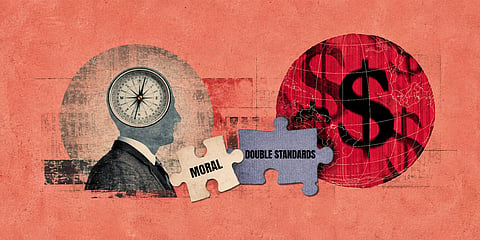
This is how justice works in Saudi Arabia. Two systems of law exist side by side. One is for the wretched mass of migrant workers and servants from the poorest countries of South Asia and Africa, for whom Shariah is literal, swift, secret and final, and designed to terrorise.
The other is for the self-appointed custodians of the Prophet's holy cities, for whom Shariah is a brand, marketed abroad and suspended at home, so that the only law that ever reaches them is the one a London coroner or a Los Angeles detective briefly applies before diplomacy intervenes. The hypocrisy is not a flaw in the structure. It is the structure. The executions of the poor are what makes the piety look real, and the piety is what makes the oil money look clean.
Every arms deal, every sovereign-wealth investment in a British football club or an American golf tour, every red carpet on the South Lawn sends the clearest of messages to Riyadh: the price of a Khashoggi is zero, and the price of a Nazrul and a Sweety is less than zero, because no one in Washington or London will ever say their names.
The "rules-based order" is applied ruthlessly to the weak and rescinded politely for the powerful. Human rights advocacy, much like the War on Terror before it, turns out to be a handy tool for whoever holds it.
So weigh it honestly. Two migrant workers have been put to death for an act their killers chose to keep secret. They died without a lawyer anyone can name, without a trial record their families will ever see. Their bodies remain in Saudi Arabia while their government waits politely for a letter.
On the other side of the scale, a prince who ordered a journalist cut to pieces stands on a red carpet beside the most powerful man on earth, who shrugs and says things happen. The kingdom has decided which lives matter. The question that should keep democracies awake at night is simpler: when did they decide to agree?
--
Zulkarnain Saer is an investigative journalist