
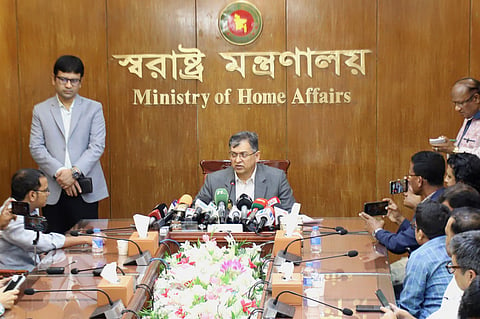
Home Minister likens AL to Nazi Germany, says ‘No genocidal force has ever returned to politics’
Home Minister Salahuddin Ahmed on Wednesday said the Awami League would never be allowed to return to politics in Bangladesh, accusing the party of having transformed itself into a terrorist organisation through its activities.
“History bears witness that no genocidal, fascist or mafia force, like Nazi Germany, has ever been able to return to politics anywhere in the world,” he said. “The banned Awami League will never be able to return to Bangladesh or engage in democratic politics.”
He made the remarks at a press briefing on contemporary issues at the Home Ministry's conference room at the Bangladesh Secretariat.
He said the people of Bangladesh would no longer recognise it as a political party.
Asked about Hasina's announcement that she wanted to return to Bangladesh, Salahuddin said a fugitive facing conviction could return only through the extradition process under the relevant treaty.
“The government had already sent a letter to the country concerned through diplomatic channels via the Foreign Ministry,” he said, adding that the country had indicated it would examine the matter in accordance with its laws.
Referring to repeated announcements about Hasina's possible return, Salahuddin said the dates had shifted from November to December and, most recently, to December 16. “How long will this ‘I will come, I will come’ continue?” he asked, adding that the government was neither concerned nor under pressure over the issue. He said law enforcement agencies remained alert.
The minister alleged that fugitive Awami League leaders operating from across Bangladesh's western and eastern borders were directing party activists inside the country to organise disruptive programmes, including torch processions, lockdowns, shutdowns and hartals. He accused them of misleading their supporters and putting them at risk by encouraging such activities.
He said law enforcement agencies had thwarted previous attempts through patient and strategic action without any loss of life or property. He warned that anyone involved in extremist activities, arson or attacks on public life and property would face strict legal action.
Asked whether the Awami League would be formally banned as a political party, he said, “The matter was part of an ongoing judicial process. The International Crimes (Tribunals) (Amendment) Act, 2026, and Article 47 of the Constitution provide for the prosecution of individuals as well as political parties and organisations for crimes against humanity”.
“The activities of the Awami League and its affiliated organisations had already been banned through a government notification during the interim administration, while the Election Commission had suspended the party's registration,” he added.
Responding to a question about sabotage in Gopalganj and the alleged involvement of police officials, Salahuddin said several officers had been arrested and charged with sedition.
Departmental proceedings had also been initiated against them based on specific information about their alleged political bias or involvement in a conspiracy while serving in government positions.
“An additional superintendent of police who was from and serving in Muksudpur upazila of Gopalganj had recently been placed on attachment,” he added.
On labour unrest in the garment sector, the minister said the minimum wage had been determined and signed through the wage board in a democratic process with the consent of representatives of both employers and workers. He claimed that genuine workers and employers were satisfied with the agreement.
Those spreading rumours and attempting to create disorder in industrial areas were not genuine workers, he alleged, adding that a group was trying to exploit the issue for political purposes. Law enforcement agencies were handling the situation cautiously and investigating those behind the unrest, he said.
Salahuddin also said Prime Minister Tarique Rahman had already met several leaders of the National Citizen Party (NCP). The government planned to hold discussions with other political parties as part of broader engagement with anti-fascist political forces, he added.
Regarding the deployment of Border Guard Bangladesh (BGB) personnel in different districts, the minister said deploying the force alongside police and other agencies was a routine measure based on intelligence assessments. Forces were sent to areas where intelligence suggested a risk of unrest, he said.
Preparations for the smooth and uninterrupted celebration of Victory Day had also been completed following an inter-ministerial meeting led by the Home Ministry, he added.